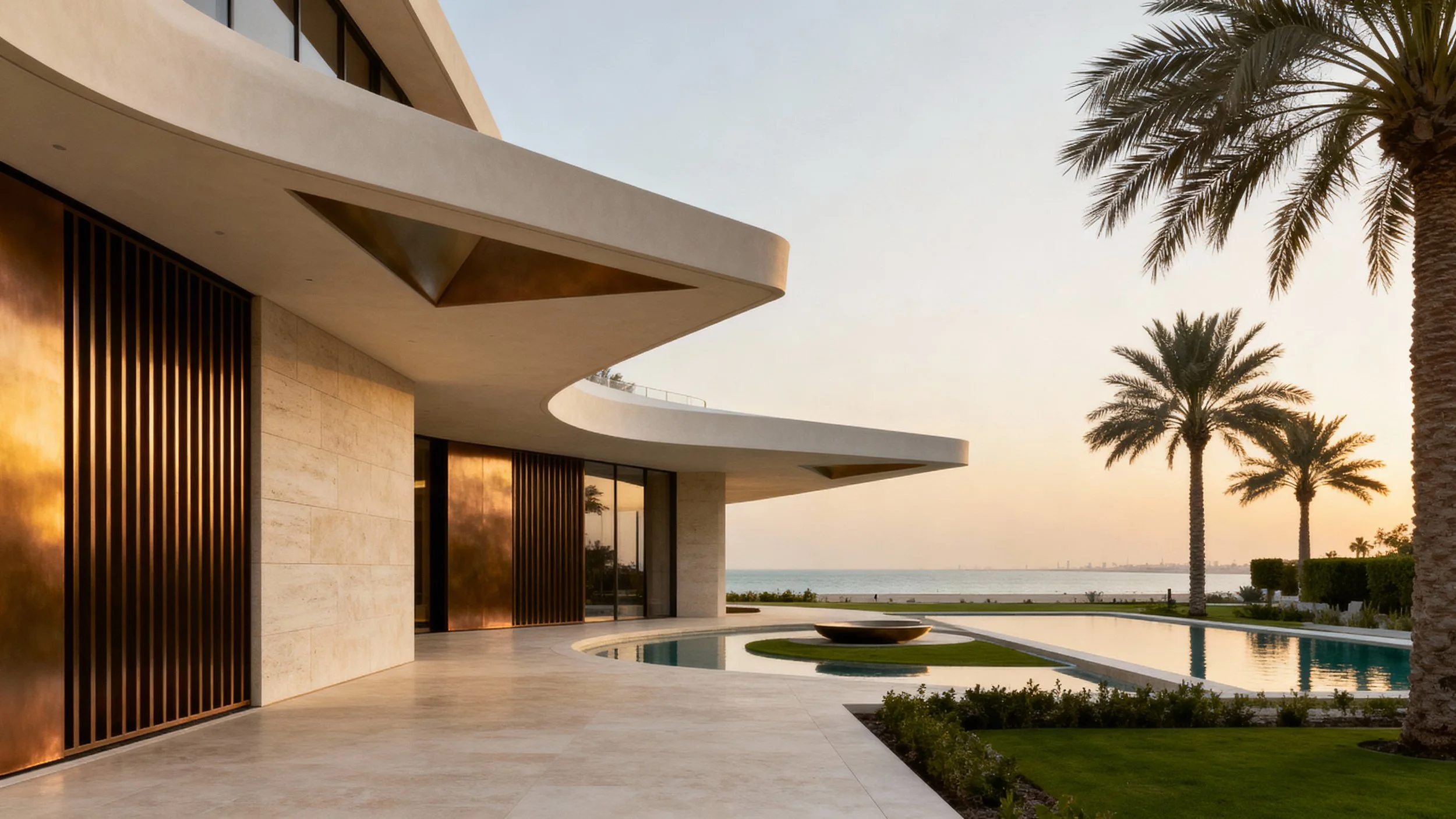
The architecture of the UAE coast tells a fundamentally different story from the interior desert.
Where Central Najdi architecture evolved massive walls and enclosed courtyards to survive extreme aridity, UAE coastal architecture developed lighter construction, open circulation, and wind-responsive strategies—solutions born from maritime trade, pearling culture, and the moderating influence of the Gulf itself.
This villa explores what happens when you translate that coastal intelligence into contemporary residential design—not through nostalgic recreation, but through deep understanding of the environmental and cultural logic that shaped traditional Emirati building.
The principles that made historic UAE architecture successful remain relevant. The question is how to express them through contemporary materials, engineering, and spatial expectations.
The Foundation: Understanding Coastal Logic
Traditional UAE architecture wasn’t imported from elsewhere. It evolved as a specific response to coastal climate, available materials, and a culture defined by maritime trade.
Lighter construction using coral stone, gypsum, and palm fronds created buildings that responded to humidity and salt air—materials that could be sourced locally and replaced as needed.
Wind towers (barjeel) captured prevailing sea breezes and directed them through interior spaces, creating natural ventilation that made buildings livable without mechanical cooling in a humid climate.
Open spatial planning reflected trading culture—majlis spaces designed for receiving merchants and guests, circulation patterns that maintained privacy while enabling hospitality, thresholds that welcomed while controlling access.
Horizontal emphasis characterised buildings that spread across sites rather than building vertically—creating shaded courtyards, covered walkways, and protected outdoor spaces that maximised cross-ventilation.
This was architecture in dialogue with the sea—responsive to breezes, designed for humidity management, built from materials that aged gracefully in salt air.
The challenge: How do you honour this coastal wisdom while creating contemporary luxury residences that serve how families want to live today?
Translating Lightness: The Curved Canopy
The most striking element of this villa is the series of curved, sweeping canopies that appear to float above the structure—dramatic horizontal planes that extend far beyond the building envelope.
This isn’t formal gesture for its own sake. It’s a contemporary translation of how traditional UAE buildings achieved protection through lightness rather than mass.
Where inland desert architecture used thick walls for thermal protection, coastal architecture used extended rooflines and shaded verandas—horizontal projections that created deep shadows while allowing air to circulate freely beneath.
These canopies translate that principle through contemporary engineering. Thin concrete shells—made possible by advanced structural design—create vast overhangs that:
Shield from intense sun while remaining visually light, appearing to hover rather than bear down.
Channel sea breezes beneath and around the structure, creating natural airflow patterns that reduce mechanical cooling loads.
Frame views of the water and horizon without creating visual barriers—you’re protected but remain connected to the coastal landscape.
Create graduated thresholds from full sun exposure to deep shade to interior space—the same layered environmental control traditional buildings achieved through covered walkways and courtyards.
Stand beneath these canopies on a humid afternoon with Gulf breezes moving through, and you experience what Emirati builders understood: in coastal climates, the most sophisticated climate control is movement of air, not sealing against it.
The curves themselves reference the organic forms found in maritime contexts—dhow sails catching wind, the fluid lines of boats designed to move through water—translated into permanent architecture that maintains visual connection to the sea.
Translating Openness: Horizontal Flow
Traditional UAE buildings were characterised by horizontal spread—compounds of connected pavilions, covered walkways linking spaces, buildings that embraced their sites rather than rising vertically from them.
This villa continues that horizontal emphasis through its strong stratification—clearly defined floor plates that extend generously, creating multiple levels of protected outdoor space.
Where a Najdi villa might be vertically composed with stacked volumes creating hierarchical privacy (as explored in our Central Najdi translation), this coastal villa spreads horizontally—each level extending toward the water, maximising connection to sea views and breezes.
The spatial planning reflects trading culture’s hospitality patterns:
Generous entry sequences that welcome without immediately exposing private family areas—thresholds that control access while expressing openness.
Layered social spaces that allow simultaneous hosting of guests and maintenance of family privacy—the contemporary equivalent of merchant majlis receiving areas separate from family quarters.
Visual permeability where interior spaces maintain connection to exterior landscape and water—transparent rather than enclosed, trusting in threshold design rather than solid barriers for privacy.
This is fundamentally different from interior desert planning, which prioritised fortified enclosure. Coastal culture was outward-facing—engaging with sea trade, receiving merchants from across the Gulf and Indian Ocean, building identity through exchange rather than isolation.
Translating Natural Ventilation: The Barjeel Principle
The iconic wind tower (barjeel) represents one of the most sophisticated passive cooling strategies ever developed—capturing high-altitude breezes and directing them down into interior spaces, creating natural convection currents that made buildings comfortable despite heat and humidity.
This villa doesn’t include literal wind towers—that would be pastiche. Instead, it translates the principle of wind capture and directional airflow into contemporary spatial and material strategies.
Vertical circulation cores positioned to create pressure differentials, drawing air up through the building as it heats.
Strategic placement of openings at different heights, creating convection currents that pull sea breezes through living spaces without mechanical assistance.
Material choices that don’t trap heat—the travertine cladding absorbs less heat than darker stone, while its thermal mass helps moderate temperature swings even in humid conditions.
Deep overhangs that shade glazed openings, preventing greenhouse effect while allowing windows to remain open for cross-ventilation.
The bronze and timber screens aren’t purely aesthetic—they function as selective air filters, allowing breezes to pass while diffusing direct sun and maintaining visual privacy. As sea breezes move through these screens, they create subtle pressure differences that enhance natural ventilation patterns.
This is contemporary interpretation of barjeel logic: understanding that in coastal climates, comfort comes from air movement, not air sealing. The building is designed to breathe with the rhythms of the Gulf—morning breezes from the water, afternoon sea winds, evening cooling.
Translating Materials: Coastal Weathering
Traditional UAE buildings used materials that responded honestly to maritime climate—coral stone that absorbed and released moisture, gypsum that could be regularly refreshed, palm timber that aged in salt air.
This villa continues that material honesty through contemporary choices designed to weather gracefully in coastal conditions.
Travertine cladding provides the warm, light-toned aesthetic of traditional coastal buildings while offering superior durability. Unlike coral stone, which could deteriorate in salt air, modern travertine is sealed and detailed to resist salt damage while maintaining visual connection to historic palette.
Bronze is ideal for coastal environments—it naturally forms a protective verde patina in salt air that actually enhances the material's visual depth. This self-protecting finish means the screens gain character rather than requiring replacement, a contemporary echo of how traditional builders selected materials that harmonized with their climate rather than fought against it.
Timber elements use species selected for marine environment performance—hardwoods that resist rot and insect damage while developing the silver-grey patina that aged timber acquires in humid, salty conditions.
These aren’t maintenance-free materials (nothing truly is in marine environments). But they’re materials that age with dignity—developing character rather than simply deteriorating, telling the story of their climate rather than fighting against it.
In twenty years, this villa will have weathered. The bronze will have deepened its patina. The timber will have silvered. The stone will have developed subtle variations where rain and salt air have marked it.
That aging process is intentional—architecture designed for inheritance, not novelty.
Translating the Relationship to Water
In desert architecture, water is symbol and sanctuary—precious, carefully deployed, psychologically powerful as oasis within aridity. (This is explored in depth in our Najdi villa analysis.)
In coastal architecture, water is context and connection—the omnipresent Gulf that defines the site, moderates the climate, and historically provided livelihood.
This villa’s relationship to water reflects that difference.
The reflection pool doesn’t function as symbolic oasis. It operates as visual extension of the Gulf itself—a threshold between built environment and natural water, creating the illusion that the sea continues right to the building’s edge.
The horizontal emphasis of terraces and canopies creates multiple viewing platforms—spaces designed specifically for looking out toward the water, for watching dhows pass, for experiencing sunrise and sunset over the Gulf.
The transparent ground level maintains visual connection from interior spaces through to the water beyond—you’re never enclosed away from the sea; it remains present even from deep within the building.
Where desert architecture used water as contrast to its environment (coolness against heat, fluidity against arid harshness), coastal architecture uses water as continuity—the building exists in conversation with the Gulf, not in opposition to it.
The pool also serves practical functions familiar from coastal building traditions:
Evaporative cooling enhances the micro-climate, though in humid conditions this is less pronounced than in arid zones.
Sound modulation creates ambient audio that masks urban noise while reinforcing the sense of being at the water’s edge.
Reflective light bounces into deeply shaded areas beneath the canopies, preventing them from becoming dark despite being protected from direct sun.
What Makes This Coastal (Not Desert)
The differences from our Najdi villa concept are instructive—they reveal how the same translation methodology produces entirely different formal outcomes when responding to different environmental and cultural contexts.
Horizontal vs. Vertical: The Najdi villa uses vertical stacking and angular faceting; this coastal villa spreads horizontally with curved, flowing forms.
Enclosure vs. Openness: The Najdi villa creates graduated enclosure moving inward; this villa maintains visual permeability and connection to surrounding landscape.
Mass vs. Lightness: The Najdi villa uses material mass (travertine) for thermal protection; this villa uses extended thin planes for shade while emphasizing visual lightness.
Air Sealing vs. Air Movement: The Najdi villa minimises openings and controls exposure; this villa maximises airflow and embraces breezes.
Symbolic Water vs. Contextual Water: The Najdi villa uses water as oasis symbol; this villa uses water as connection to the Gulf.
Both approaches are contemporary. Both are sophisticated. Both honour regional heritage without replicating historical forms.
But they’re responding to fundamentally different environmental logics and cultural patterns—which is exactly the point. Translation methodology remains consistent; formal outcomes are always site-specific.
The Curve as Cultural Language
One element deserves particular attention: the sweeping curves that define this villa’s formal language.
These aren’t arbitrary gestures or fashionable parametricism. They’re cultural and functional translation.
Maritime forms have always been curved—dhow hulls designed to move through water, sails catching wind, the organic geometry of boats shaped by centuries of navigational refinement.
Aerodynamic efficiency means curved surfaces interact with sea breezes differently than angular planes—directing airflow rather than blocking it, creating laminar flow patterns that enhance natural ventilation.
Visual softness contrasts with the angular geometry often associated with desert architecture—reflecting the different psychological relationship coastal culture has with its environment (engagement rather than fortification).
Structural elegance is enabled by contemporary engineering—thin concrete shells forming dramatic curves that would have been impossible with traditional materials, but which continue the principle of achieving protection through sophisticated geometry rather than massive construction.
This is why formal language matters in heritage translation—not as decoration, but as expression of deeper environmental and cultural logic.
Restrained Elegance as Coastal Tradition
Here’s what became clear as this design developed: the villa’s minimalist aesthetic isn’t an imported international style—it’s actually a continuation of coastal building wisdom.
Traditional UAE architecture was never about ornamental excess. In maritime environments where salt air, humidity, and wind shaped every decision, builders developed a different kind of sophistication:
Applied decoration was reserved for protected elements—carved doors, gypsum screens—while exposed surfaces remained honest and simple.
Visual interest came from how light played across textured surfaces throughout the day, not from decorative elaboration.
Form followed climate—buildings were shaped by how they needed to perform in humid, breezy conditions.
This villa honours that legacy. Simple volumes that let materials speak. Restrained palette that ages gracefully. Design decisions driven by environmental logic rather than decorative impulse.
Modern engineering allows gestures traditional builders couldn’t achieve—structurally ambitious curves, expansive glazing, dramatic cantilevers. But the core principle endures: true sophistication emerges from restraint, not embellishment.
This isn’t minimalism because it’s trendy. It’s minimalism because it’s historically appropriate—continuing the visual discipline that defined Emirati coastal building for generations.
For Dubai Developers and UAE Clients
This villa demonstrates what heritage-informed contemporary design means in UAE coastal context—something fundamentally different from interior desert traditions, yet equally rooted in place.
For Emirati families seeking homes that honour UAE heritage while serving contemporary living: This shows what authentic coastal modernity looks like—open to sea breezes, connected to the Gulf, designed for hospitality and family life while maintaining privacy.
For Dubai developers pursuing differentiation: This represents an alternative to both generic glass towers and superficial ‘Arabian’ decoration—architecture that feels distinctly Emirati in its environmental responsiveness and cultural intelligence while remaining unmistakably contemporary in execution.
For international buyers seeking luxury with meaning: This offers what generic towers cannot—a sense of place, of belonging to specific coastal context, of inhabiting architecture that responds to its environment rather than fighting against it.
The UAE’s coastal architectural heritage is as sophisticated as any Gulf tradition—it simply evolved different solutions to different environmental and cultural challenges. Wind towers instead of thick walls. Horizontal spread instead of vertical enclosure. Lightness instead of mass. Openness instead of fortification.
This villa translates that coastal intelligence into contemporary form—not through nostalgic recreation, but through deep understanding of the principles that made traditional Emirati architecture successful, expressed through the materials and methods of today.
Principles, Not Pastiche
What this villa shares with our Najdi concept isn’t formal language—the two projects look entirely different.
What they share is methodology: Listen deeply to regional tradition. Extract core environmental and cultural logic. Translate those principles through contemporary materials, engineering, and spatial expectations. Allow authentic formal language to emerge from that process.
The measure of successful translation isn’t visual reference to historical precedent. It’s whether the architecture embodies the same environmental intelligence, spatial logic, and cultural values—expressed through contemporary means.
This villa doesn’t include literal wind towers, coral stone construction, or palm-frond roofing. But it captures what made those traditional strategies successful: understanding that coastal climate requires buildings to embrace airflow, that humidity management differs fundamentally from arid-zone cooling, that maritime culture created different spatial patterns than desert culture.
The result is architecture that feels distinctly Emirati—rooted in coastal heritage, responsive to Gulf breezes, connected to the sea—while belonging unmistakably to the 21st century.
Architecture That Breathes
This coastal villa embodies our conviction that heritage-informed design means understanding why traditional architecture worked, not copying what it looked like.
The process begins with listening—to how sea breezes move, to how materials weather in salt air, to what made Emirati builders successful for generations.
Then we translate—expressing those same environmental and cultural principles through contemporary engineering, modern materials, and spatial logic suited to how families live today.
The result doesn’t reference coastal heritage through obvious symbols. It continues that heritage through performance—through how air moves, how light filters, how materials age, how spaces balance hospitality with privacy.
For the UAE coast, that means buildings that breathe with Gulf rhythms, that connect to rather than compete with the sea, that embrace horizontal openness rather than vertical enclosure, that will still feel right decades from now.
This is architecture that earns its authenticity not through visual references, but through deep intelligence—translating heritage without freezing it, honouring tradition while embracing the future.
— Werner van Blerk
For broader context on our Gulf design philosophy: The Oasis Principle | Beyond Spectacle: How the Gulf is Redefining Luxury Through Cultural Identity | Desert Minimalism Reimagined: Translating Central Najdi Architecture