Central Najdi architecture represents one of humanity’s most refined responses to extreme climate. Over centuries, builders in Riyadh and across the Nejd plateau evolved solutions that weren’t decorative—they were survival refined into built form.
The question this villa explores: How do you translate that environmental and cultural intelligence into contemporary residential design without copying historical forms?
The answer lies in understanding principles, not patterns—extracting the essential logic that made traditional Najdi architecture successful, then expressing those principles through contemporary materials, engineering, and spatial expectations.
Let me walk through how that translation works in practice.
The Foundation: Understanding Najdi Logic
In a landscape where summer temperatures regularly exceed 45°C, traditional Najdi builders evolved specific strategies:
Thick mudbrick walls provided thermal mass—absorbing heat during the day, releasing it slowly at night, creating interior temperatures significantly cooler than exterior conditions without mechanical systems.
Small, strategically positioned windows minimised solar gain while distinctive triangular openings—the furjat—created filtered light and cross-ventilation without compromising thermal performance.
Geometric restraint defined the aesthetic. Beauty emerged from proportion, shadow play, and honest structural expression—not applied decoration.
Inward-focused planning used thick perimeter walls to create fortified compounds protecting interior courtyards—micro-climates of life within harsh surroundings.
This wasn’t style. It was climatic wisdom made architectural.
The challenge: How do you honour this wisdom while serving contemporary expectations for spatial openness, visual connection to landscape, and material sophistication?
Translating Mass: The Cantilever Strategy
Traditional Najdi buildings achieved thermal protection through mass—thick walls that absorbed and moderated temperature extremes through sheer material volume.
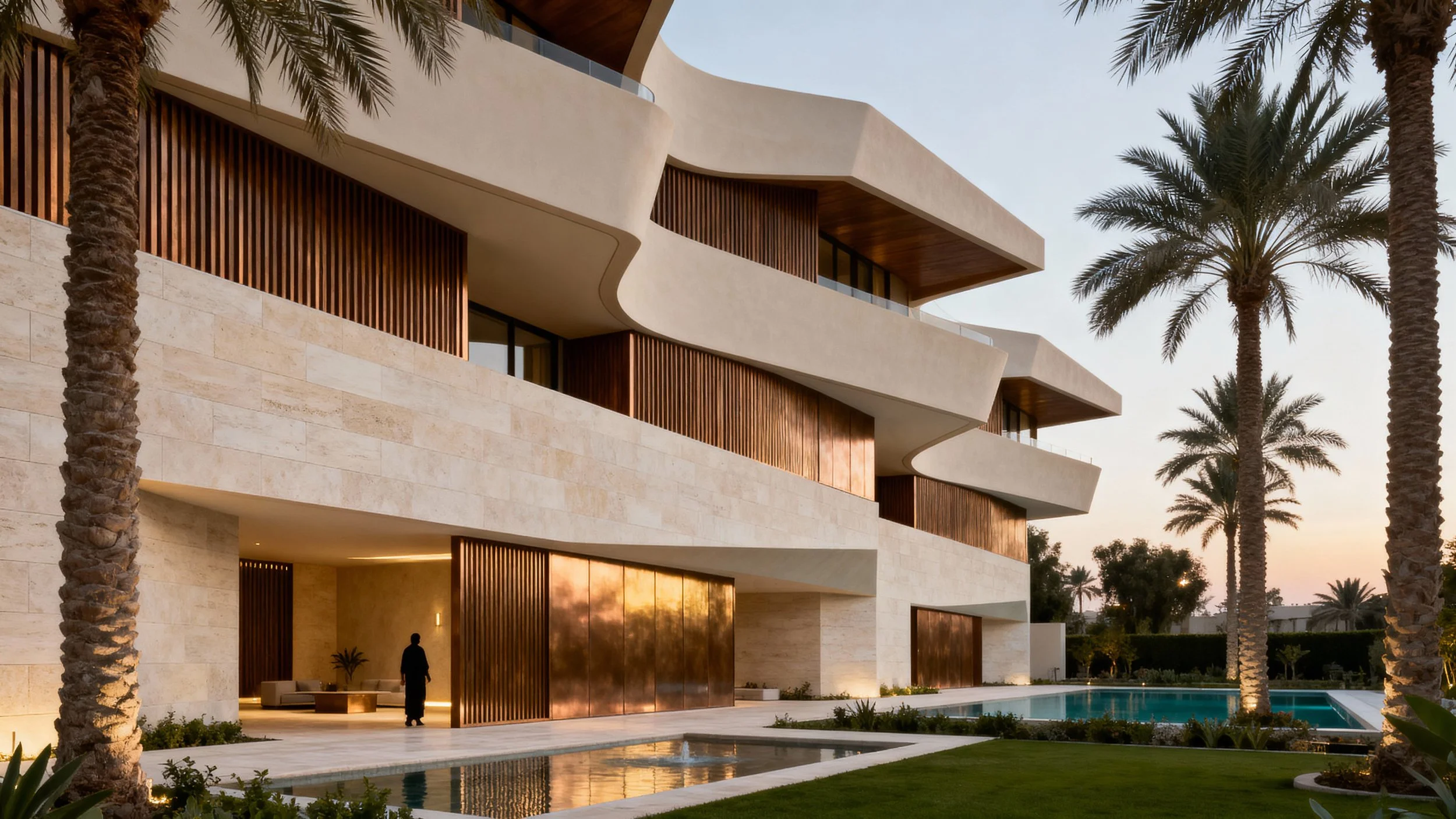
This villa translates that principle into projection—dramatically cantilevered upper volumes that shades the entire south-facing facade, creating deep recesses protecting floor-to-ceiling glazing from direct solar exposure.
Same thermal outcome. Different structural expression.
The engineering is contemporary—post-tensioned cantilever construction allowing dramatic extension without visible support. But the principle is ancient: create protective shade through bold geometric gesture.
The cantilevers cast shifting shadows throughout the day—morning protection on eastern facades, afternoon shade moving westward. The building performs as a solar calendar, its shadow patterns marking time as precisely as traditional courtyard architecture did.
Stand beneath these overhangs at midday in July, and you experience what Najdi builders understood intuitively: the most effective climate control prevents heat from reaching surfaces in the first place, rather than extracting it after absorption.
Translating Thermal Performance: Stone as Strategy
The specification of natural travertine for the lower level demonstrates understanding of Najdi building principles at the material level.
Travertine possesses significant thermal mass—functioning like the adobe of traditional construction by absorbing heat during peak hours and releasing it slowly overnight, moderating interior temperature swings.
But the application is contemporary. Where historic Najdi walls were 60-80cm thick, relying entirely on mass for thermal performance, this design uses 3-4cm travertine cladding backed by modern insulation systems and integrated building envelopes.
We’re using the material’s thermal properties in combination with advanced building science, achieving superior performance with far less material volume.
The visual result echoes the warm earth tones of adobe while remaining unmistakably contemporary in precision and detailing. The stone is left relatively plain—its natural grain, colour variation, and texture provide visual richness without applied ornament.
Over time, this travertine will weather and patina, telling the story of its climate. That aging process is intentional—architecture designed for generational timescales rather than Instagram immediacy.
Translating Light Control: The Furjat Reimagined
Traditional Najdi buildings featured the furjat—triangular openings that solved multiple problems simultaneously:
Reduced solar heat gain through smaller apertures
Created cross-ventilation without compromising security
Maintained visual privacy for interior inhabitants
Produced ever-changing light patterns marking time throughout the day
The vertical bronze and timber screens translate this multi-functional logic into contemporary fabrication.
Precision-manufactured slats create controlled light filtration—allowing visibility outward while preventing direct views inward. The geometry responds to seasonal sun angles: aggressive shading in summer when the sun is higher, allowing winter light penetration when the sun sits lower on the horizon.
The matte bronze finish is designed to patina naturally over time, developing a rich oxide coating that deepens visual character. Unlike polished metals that show every mark as damage, this bronze improves with age—a visible timeline accumulating meaning.
As light passes through these screens throughout the day, it creates moving shadow patterns on interior surfaces—the same phenomenon traditional furjat created, but executed through contemporary precision rather than hand-carved apertures.
This is translation: capturing the function and philosophy of historical elements while abandoning literal replication.
Translating Enclosure: Courtyards Reconsidered
Traditional Najdi residential compounds were fundamentally inward-focused—thick perimeter walls creating fortified enclosures protecting interior courtyards where family life unfolded, shielded from harsh environment and public view.
This villa translates the principle of protected outdoor space while inverting the spatial strategy for contemporary expectations.
Rather than fully enclosed courtyards, the design creates layered thresholds: from open landscape to covered terraces beneath the cantilevers, to screened transition zones, finally to fully enclosed interiors.
Each layer offers different micro-climate and privacy:
Open landscape connects the villa to its desert context—palms and cultivated green representing The Oasis Principle.
Covered terraces beneath the cantilevers provides protected outdoor living—shaded, cooled by evaporative effect from the reflection pool, yet visually open to landscape.
Screened zones behind bronze and wood elements create semi-private transitions—you can see out, but passersby cannot clearly see in.
Enclosed interiors offer complete climate control and privacy.
This graduated system serves the same privacy and climatic functions as traditional courtyard planning, adapted to contemporary luxury living where visual connection to landscape is valued alongside protection from it.
Translating Symbolism: Water as Micro-climate
In the desert, water is never merely decorative.
The reflection pool extending along the facade serves the same functions that courtyard fountains served in historic Najdi palaces—practical, climatic, and symbolic simultaneously.
Evaporative cooling creates immediate micro-climate. On a 45°C afternoon, the temperature difference between areas adjacent to water and those several meters away can be 3-5°C—meaningful passive cooling without mechanical intervention.
Reflective surfaces bounce light into deeply recessed spaces beneath the cantilever, preventing them from becoming dark despite being shielded from direct sun.
Cultural resonance matters. Water in Islamic tradition represents life, sanctuary, and divine blessing. Generous deployment of water in a desert residence isn’t wasteful luxury—it’s creating sanctuary, establishing a protected realm of life within harsh surroundings.
Historic Najdi wealthy families maintained elaborate courtyard water features precisely because they represented the intersection of climatic intelligence and cultural symbolism. This design continues that tradition through contemporary expression.
The Unexpected Translation: Minimalism as Cultural Continuity
As this design developed, something became clear: the villa’s minimalist aesthetic isn’t imported international style—it’s actually cultural continuity.
Traditional Najdi architecture was defined by geometric restraint. Ornamentation was minimal. Beauty emerged from proportion, from light and shadow play across simple surfaces, from honest structural expression.
The aesthetic was necessity-driven simplicity—in extreme climates with limited resources, every element had to justify its existence functionally before it could be considered decoratively.
This villa continues that tradition of restraint. Clean volumes. Limited material palette. Absence of applied ornament. Beauty emerging from proportion and shadow rather than decoration.
Contemporary engineering enables what traditional builders couldn’t achieve—dramatic cantilevers, expansive glazing, precision-fabricated screens. But the underlying aesthetic principle remains: sophistication lies in restraint rather than embellishment.
We’re not imposing minimalism because it’s fashionable internationally. We’re working in a restrained language because it’s culturally appropriate—honouring the aesthetic discipline that defined historic Najdi building.
Both traditions celebrate the interplay of solid and void, light and shadow, enclosure and opening. The difference lies in execution, not intent.
What ‘Translation’ Actually Means
This villa demonstrates a specific methodology for engaging with architectural heritage:
Not reproduction — We don’t copy historical forms or recreate visual references
Not superficial reference — We don’t apply mashrabiya screens as decoration or quote Najdi arches symbolically
Translation of principles — We extract core environmental and spatial logic:
Thermal protection through bold geometric shade strategies
Materials with appropriate thermal properties
Controlled light filtration maintaining privacy
Protected outdoor spaces creating micro-climates
Geometric restraint and honest material expression
Then we express those principles through contemporary materials, advanced engineering, and current spatial expectations.
The result: architecture that feels distinctly rooted in Riyadh—in its climate, cultural traditions, desert context—while belonging unmistakably to the 21st century.
The False Choice Dissolved
This approach dissolves the false choice between heritage reproduction and placeless modernism.
You don’t have to choose between honouring Central Najdi architectural wisdom and creating genuinely contemporary residential design. You don’t have to choose between cultural authenticity and spatial sophistication.
You translate. You listen deeply to what made traditional architecture successful, then speak in contemporary language.
The measure of successful translation isn’t visual similarity to historical precedent. It’s whether the architecture embodies the same environmental intelligence, spatial logic, and cultural values—expressed through the materials and methods of today.
For Those Seeking Authentic Modernity
As Saudi Arabia implements its architectural heritage initiative across 19 distinct regional styles, this villa demonstrates what heritage-informed contemporary design can achieve when approached as translation rather than replication.
For Saudi families seeking homes that honour the Kingdom’s architectural heritage while serving contemporary living: this shows what authentic modernity looks like—rooted in place, sophisticated in execution, designed for how you want to live today.
For developers pursuing differentiation in a market saturated with generic modernism or literal heritage reproduction: this represents a third path—cultural intelligence expressed through contemporary sophistication.
For architects engaging with regional traditions: this proposes a methodology—shift from ‘what should it look like?’ to ‘what principles should it embody?’—then allow contemporary form to emerge from that deeper engagement.
Architecture That Listens
This villa represents our conviction that the most meaningful contemporary architecture doesn’t impose predetermined formal languages.
It listens—to climate, to culture, to centuries of accumulated wisdom embedded in traditional building practices.
Then it speaks—in the language of today, using contemporary materials and engineering, serving current expectations for space and light.
The result is architecture that doesn’t announce its cultural credentials through obvious references. It embodies them through every thermal strategy, every material choice, every spatial threshold.
This is not architecture for approval. This is architecture that earns its place through Quiet Intelligence—translating heritage without embalming it, honouring tradition while serving the future.
— Werner van Blerk
For broader context on our Gulf design philosophy: The Oasis Principle | Beyond Spectacle: How the Gulf is Redefining Luxury Through Cultural Identity | Coastal Intelligence: Translating UAE Maritime Architecture into Contemporary Form